Research
I am passionate about enabling autonomous robots to safely navigate and interact in complex, changing environments. My research pursues spatiotemporal memory for embodied agents: real-time, scalable, dynamic 3D scene representations that unify multiple modalities, such as geometry (signed distance and occupancy), appearance (color) and open-vocabulary semantics, into a single memory that robots can query for safe motion planning, navigation, mobile manipulation and task planning. A recurring theme of my work is making these methods fast enough to run onboard, through C++, custom CUDA kernels and open-source software.
BubbleCBF: Constructive Safety for Second-Order Systems and Application to Autonomous Robot Navigation in Unknown Environments
We develop BubbleCBF, a constructive approach to feasible safety constraints for second-order systems. Collision-free bubbles built from signed distance queries are lifted to a velocity-dependent safe set and enforced by a quadratic-program safety filter, with guarantees of forward invariance and feasibility under bounded inputs. A differential-drive robot navigates unknown environments without collision or deadlock.
OREN-X: Octree Residual Network for Real-Time Multi-Modal Mapping
We develop OREN-X, an online mapping method that uses a single octree to store, index and jointly train signed distance, occupancy, radiance and vision-language fields in real time. Joint training sharpens the SDF, shared indexing enables 2D and 3D open-vocabulary queries, and an online dictionary compresses the vision-language features while raising query accuracy.
From Distances to Trajectories: Real-Time Signed Distance Function Mapping and Distance-Accelerated Motion Planning for UAVs
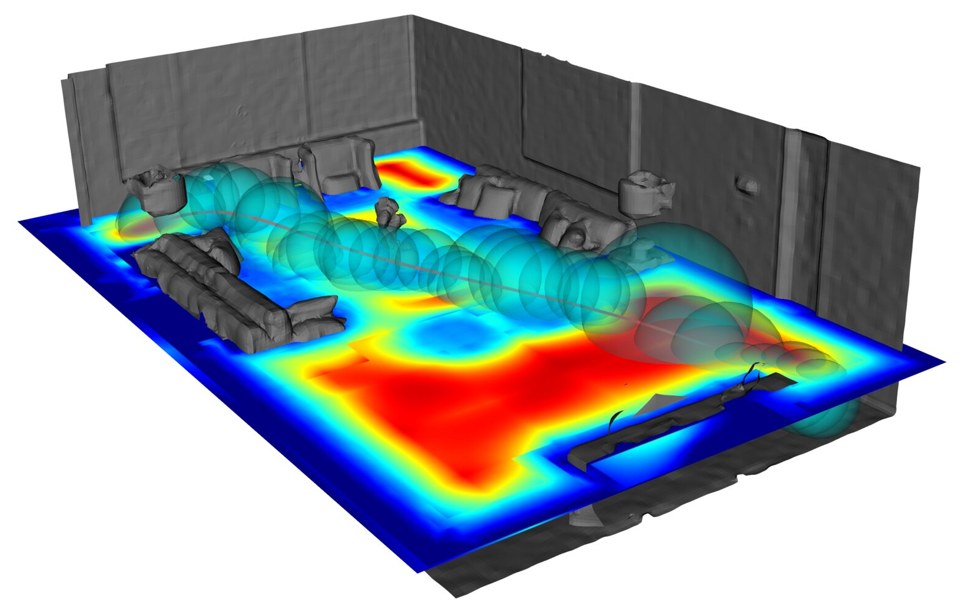
We co-design mapping and planning for autonomous flight around a single signed distance function. OREN reconstructs the SDF online, and Bubble* exploits the distance information to grow collision-free bubbles that form a safe corridor for trajectory optimization, with guarantees of termination, completeness and failure detection. The integrated system runs onboard a quadrotor in real time.
Under Review
AIMI Workshop @ ICRA 2026
Seeing the Bigger Picture: 3D Latent Mapping for Mobile Manipulation Policy Learning
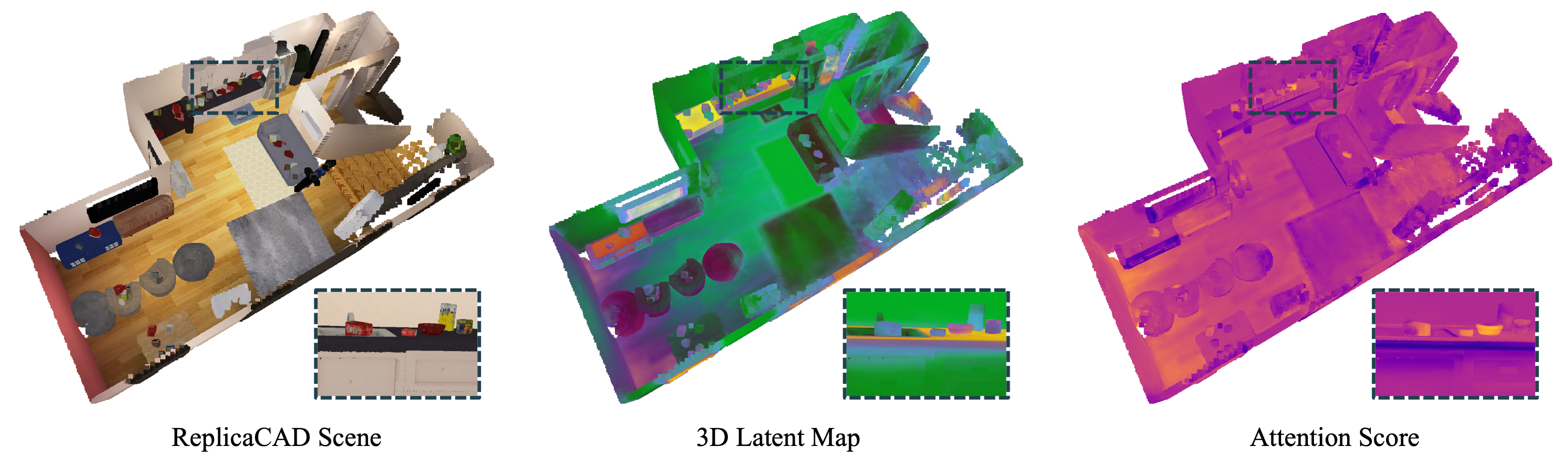
We develop Seeing the Bigger Picture (SBP), an end-to-end policy learning approach that operates directly on a 3D map of latent features. In SBP, the map extends perception beyond the robot's current field of view and aggregates observations over long horizons, which achieves stronger spatial and temporal reasoning than policies relying solely on images.
ICRA 2026
Best Paper Nomination @ RoboReps Workshop RSS 2025
LTLCodeGen: Code Generation of Syntactically Correct Temporal Logic for Robot Task Planning
We develop LTLCodeGen, a method that uses large language model (LLM) code generation to translate natural language robot navigation instructions into syntactically correct linear temporal logic (LTL) formulas that can be combined with a semantic occupancy map to generate robot trajectories satisfying the specified tasks.
Optimal Scene Graph Planning with Large Language Model Guidance
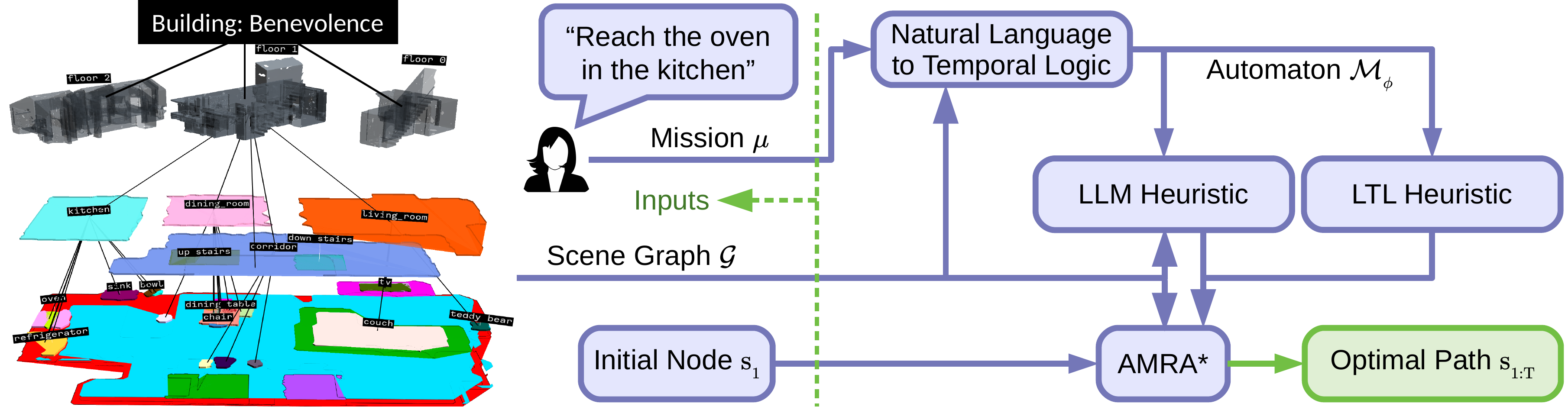
Our work enables optimal hierarchical LTL planning with LLM guidance over scene graphs. To achieve efficiency, we construct a hierarchical planning domain that captures the attributes and connectivity of the scene graph and the task automaton, and provide semantic guidance via an LLM heuristic function. To guarantee optimality, we design an LTL heuristic function that is provably consistent and supplements the potentially inadmissible LLM guidance in multi-heuristic planning.
Learning Scene-Level Signed Directional Distance Function for Aerial Autonomy
We propose Signed Directional Distance Function (SDDF), a novel 3D scene representation that encodes the signed distance from a position to the nearest surface along a direction. SDDF enhances geometry modeling, occlusion capture, collision checking and differentiable view prediction for trajectory optimization of aerial robots.
Best Paper Award @ Workshop on Leveraging Implicit Methods for Aerial Autonomy at RSS 2025
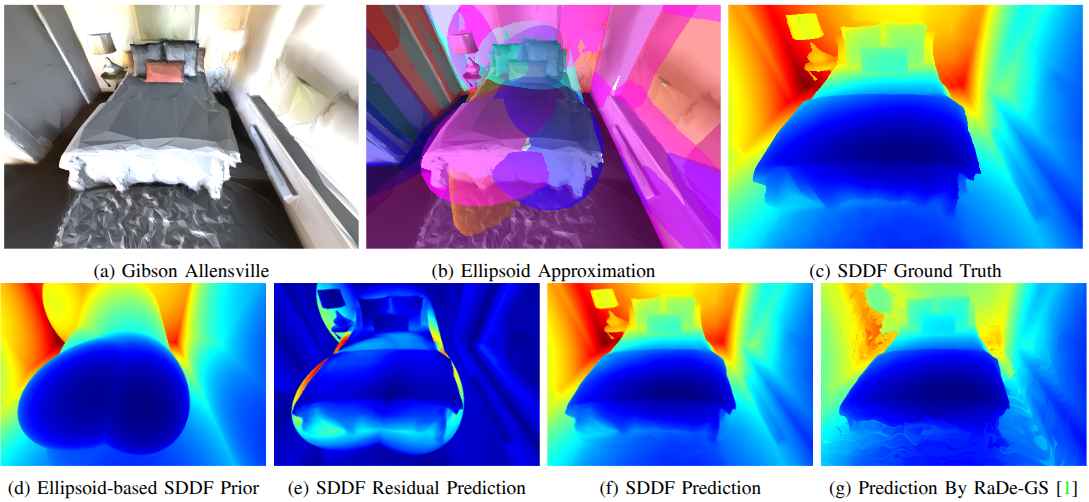
Learning Scene-Level Signed Directional Distance Function with Ellipsoidal Priors and Neural Residuals
To learn and predict scene-level SDDF efficiently, we develop a differentiable hybrid representation that combines explicit ellipsoid priors with implicit neural residuals. This approach allows the model to effectively handle large distance discontinuities around obstacle boundaries while preserving the ability for dense, high-fidelity prediction.
Best Paper Award @ Workshop on Leveraging Implicit Methods for Aerial Autonomy at RSS 2025
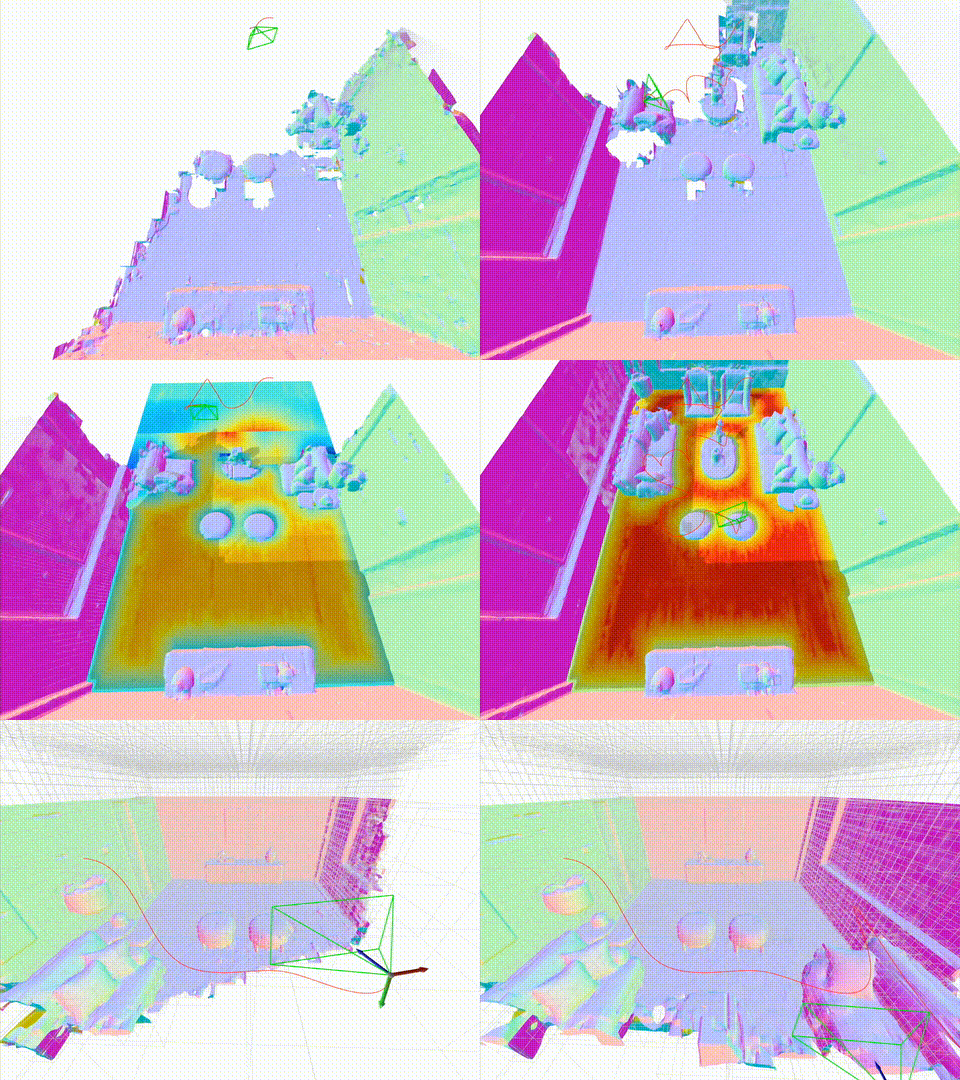
OREN: Octree Residual Network for Real-Time Euclidean Signed Distance Mapping
We propose OREN, a novel 3D scene representation that combines gradient-augmented octree interpolation with a neural residual to learn accurate signed distance functions online in real-time. OREN outperforms the SOTA neural SDF methods in SDF prediction accuracy.
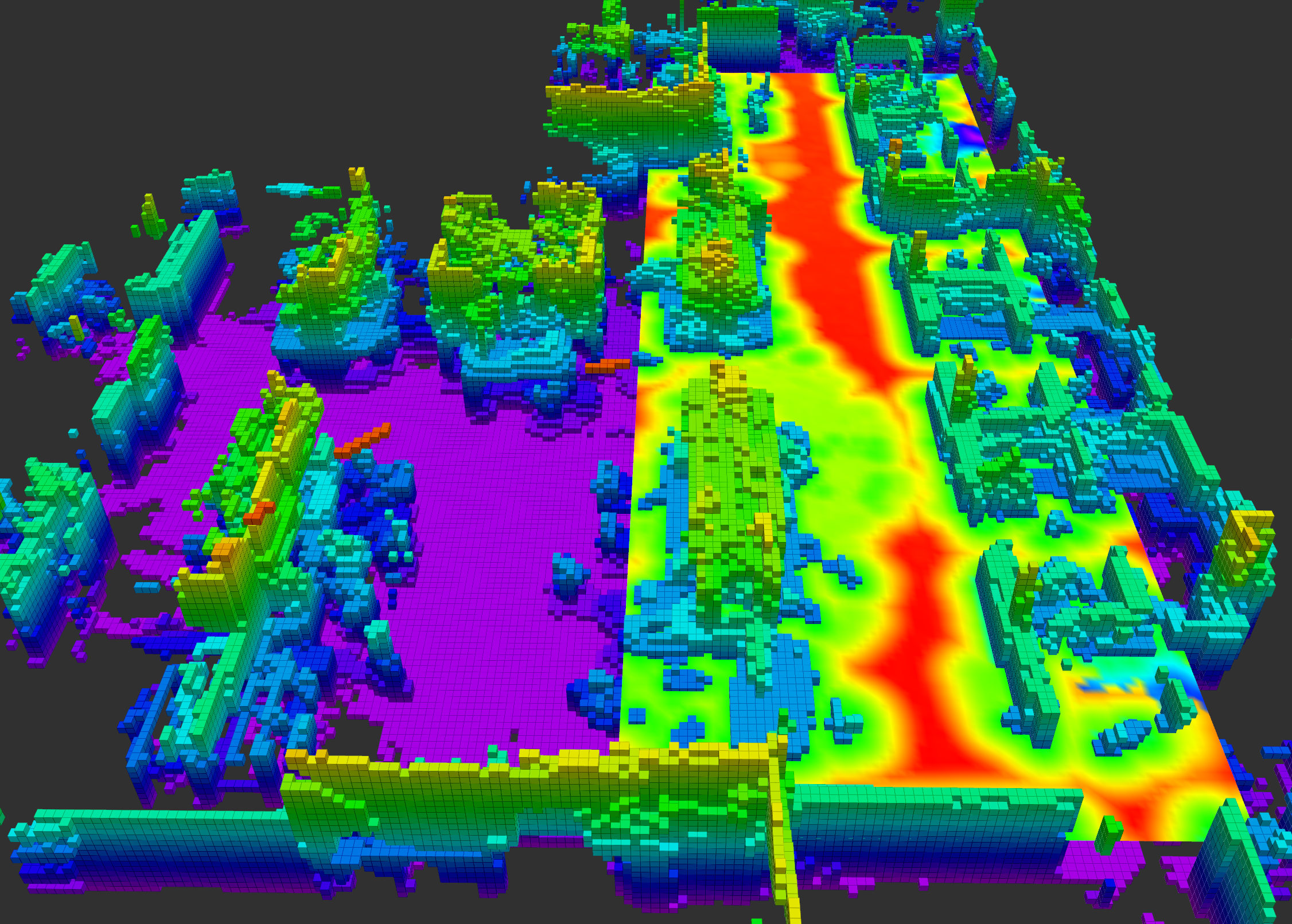
Kernel-SDF: An Open-Source Library for Real-Time Signed Distance Function Estimation using Kernel Regression
We develop Kernel-SDF, an open-source library for real-time signed distance function estimation using kernel regression. Kernel-SDF achieves superior accuracy compared to existing methods and outstanding real-time performance, making it suitable for various robotic applications requiring reliable environment representation with uncertainty awareness.
Distributionally Robust Control for Safe Robot Navigation in Dynamic Environments
We formulate distributionally robust control barrier functions (DR-CBFs) to incorporate noisy sensor measurements directly into optimization-based control synthesis, guaranteeing safe and efficient autonomous navigation in dynamic environments.